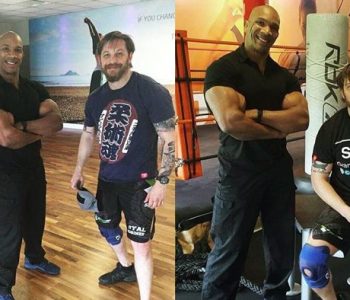
I’ve only recently become aware of Dustin Denes so this new video from Hywel Teague / BJJ Hacks couldn’t have come at a better time. What a dude!
Check it out.
| SHOP USA | |
| SHOP EUROPE & REST OF WORLD | |
| OR | |
| Close this window already, I just want to look at stuff. | |
Cookie Policy
By using this site you agree to Scramble using cookies to personalise
your shopping experience. Mmm, cookies.
I’ve only recently become aware of Dustin Denes so this new video from Hywel Teague / BJJ Hacks couldn’t have come at a better time. What a dude!
Check it out.
In part one I went over, common issues I see with conditioning for grappling sports and application of TUF methods. This one will focus on planning your conditioning approach and how to effectively work in an “inseason” between tournaments to maintain conditioning. This is more or less a lose collection of thoughts and approaches I’m using with the athletes I work with.
Having a Plan
A plan or periodisation as its know in a sport context, allows us to know when and how long we have to peak for an event. If you decide to enter to a tournament with 4 weeks or less planning, in the words of Saint Kurt “you fucked up a long time ago”. Failing to plan is planning to fail as they say. Last minute HIIT sessions in a desperate bid to get game fit 2-3 weeks out because you hesitated on entering isn’t fun.
In terms of your approach, I like fighters designate an “in season” of sorts where their greatest competition focus is going to be this could be a period of 2, 3 or even six months. Look to build strength in the “off season” and work on conditioning up to and during the in season, strength takes a back seat and is merely maintained. Obviously this isn’t always the way the competition schedule will play out over a year but do attempt to leave at least 3 months where you can focus on strength building. Strength needs a decent build up, competing demands of conditioning and technical training make it a tough balancing act.
In terms of prep we can borrow the “Fast and Frugal Peaking Tree” and “Mesocycle Sequence from http://www.scramblestuff.com/workable-periodisation-for-mma/ TUF can be applied at 4 weeks or so out.
This covers pre-competition, but what about between inter-competition periods which I would argue would be 5-4 weeks or less between events. Basically we move into quality maintenance with the right planning athletes can carry on peaking and improve on an “inseason” template if training is planned and moderated properly. Maintaining physical qualities is far easier than training to peak them, especially when usually this inter-competition periods involve plenty of hard sparring.
Strength work effectively becomes something like this
Strength In Season
Weeks 5-3 out 2 days
Main movement (bench, squat, deadlift, olift variant) (55-80% of 1RM)
2-3 Prehab, Accessory movements
Main movement (bench, squat, deadlift, olift variant) (55-80% of 1RM)
2-3 Prehab, Accessory movements
Weeks 3-0 out
Main movement (bench, squat, deadlift, olift variant) (-55% of 1RM) (using bands, chains, AFSM, Oscillatory method etc)
2-3 Prehab, Accessory movements
Main movement (bench, squat, deadlift, olift variant) (-55% of 1RM)
2-3 Prehab, Accessory movements
Conditioning In Season
But what about maintaining conditioning between competition? You need to understand the concept the of training residuals, this is the time over which a physical quality lasts after being trained to a high level. Many combat athletes fail to understand this concept and will often try to training all physical qualities all at once often right up a fight.
A number of studies (Neufer et al. 1987; Hickson, 1982) indicated that if the frequency of training is reduced by two thirds, that endurance capacities can be maintained for up to around 14 weeks. So often athletes can get away with as few as one session a week conditioning.
This can take the form of Complexes, running workouts, TUF style workouts, Fartlek. Your conditioning selection depends on your game fitness, fatigue levels and how much intense rolling you may be doing during practice. E.g. if you are beat up from sparring, TUF or HIIT circuits maybe unwise, where as running workouts or Fartlek maybe a better choice. This is context specific and a perceptive S&C coach can help a lot here. Learning to break the addiction to conditioning can be tricky especially when athletes do it year round, multiple times a week.
So for a dedicated 5 day a week BJJer with 4-5 weeks between comps may plan their week like this.
| Monday | Tuesday | Wednesday | Thursday | Friday | Saturday | Sunday |
| Strength | Conditioning | Strength | Skills | Skills | Skills | Rest |
| Pm Skills | Pm Skills |
We could even reduce load further by having only 1 strength session a week. This obviously depends on variables like schedule, access to facilities, available training time.
Wrap -up
But what is important to understand is most sports are determined by more athletic qualities than can be trained at once. This is the key I feel is often missed with upper intermediate athletes, beginners get caught in the trap of mixed methods, e.g. heavy strength work, power work, hypertrophy work, conditioning all in the same session, means all these qualities will be built poorly simultaneously. Beginners progress doing pretty much anything, because like much an unmolded peice of clay anything you do initially will start to shape it, whether you switch to a scapel later on or keep using a hammer will shape you as an athlete further down the road. Often athletes will succeed in grappling sports in-spite of their S&C because of high variability in opposition/skill ceiling in BJJ.
The key concept is maintenance versus development of physical qualities. Maintenance of strength qualities will require one to two sessions per week depending on your training experience (more advanced athletes need less I often find), whereas developing qualities such as hypertrophy or maximal strength will require the athlete to perform up to three to four sessions of strength training per week. Conditioning is a highly trainable physical quality, where as strength takes years of cultivation aerobic and anaerobic fitness can be mustered in a shorter time frame.
This is an ongoing series of articles from guest blogger and Strength & Conditioning coach William Wayland of Powering Through, who offers online training planning for tournament peaking for MMA, Nogi and BJJ
References
Hickson, RC, Kanakis Jr, C, Davis, JR, Moore, AM and Rich, S 1982, ‘Reduced training duration effects on aerobic power, endurance and cardiac growth’, Journal of Applied Physiology, 53, pp. 225–29.
Neufer, PD, Costill, DL, Fielding, RA, Flynn, MG and Kirwan, FP 1987, ‘Effect of reduced training on muscular strength and endurance in competitive swimmers’, Medicine and Science in Sports and Exercise, 19, pp. 486–90.
Attention US Scramble fans!
You can now shop for Scramble goods in your very own USA-based Scramble Store.
Benefits include:
Prices in USD!
Shipping from within the USA!
Free SCRAMBLE USA sticker with EVERY purchase!
and MORE! (actually not more.)
The store will gradually stock most of our range and there will be one or two special items coming soon.
More awesomeness from Kinya Hashimoto.
This time it’s full coverage of the IBJJF European Championships.
Check out the timestamps of all the great content below!
00:05:15 Paulo Miyao vs Keenan Cornelius
00:09:28 Joao Miyao vs Keenan Cornelius
00:14:27 Nyjah Easton vs Michelle Nicolini
00:15:57 Mackenzie Dern vs Nyjah Easton
00:19:00 Luanna Alzuguir vs Ida Hansson
00:27:32 BJJ tecnique file by Koji Asakura
00:30:48 Helvecio Penna’s match
00:33:21 Bernardo Faria vs Lucio Rodrigues
00:35:25 Romulo Barral vs Rodrigo Fajardo
00:40:25 Rodrigo Cavaca vs Alexsander Trans
00:44:08 Fernando Terere’s first match
00:44:44 Fernando Terere vs Claudio Calasans
00:49:47 Laercio Fernandes vs Carlos Holanda
00:53:53 Augusto Tanquinho vs Rubens Charles”Cobrinha”
01:01:34 Michael Langhi vs Vinicius Marinho
Another corker from Kinya Hashimoto showcasing the slick jiu jitsu emerging in Japan. If you have time I strongly recommend sitting down and watching it – there are some future world contenders on display here including Robert Satoshi and Scrambler Rikako Yuasa.
【橋本欽也の柔術プリースト #78 アブダビワールドプロ2013日本予選】
Kinya Hashimoto’s Jiu Jitsu Priest #78:Abu Dhabi World Pro Jiu Jitsu 2013 Japan Trial. Featuring Roberto Toshi, Marcos Souza, Daisuke Sugie, Kleber Koike, Akita Hosokawa, Rikako Yuasa, Sayaka Shioda, Sada Kurimori, Seringueiro Kimura, Yuki Uchiyama and more!
A friend made this for us, and we can’t stop watching it.
Check it out!

We at Scramble are very proud to support BJJ Hacks. They consistently put out some of the best BJJ video content on the internet – and for FREE.
Check out the latest, where Caio Terra talks about technique over strength and staying happy in jiu jitsu. We like it a lot.
We stumbled across this amazing blog post from the Artist Formely Known as Scrambler Dan Strauss.
Some choice highlights in his review of the Scramble Grip Trainer:
Looks
Who gives a shit how they look?
and
As you can see when looped through correctly they were shockingly strong (the hard you pull the stronger they get).
There’s also a hilarious video. Dan loves to break stuff, that’s for damn sure, but he has some real trouble getting the grip trainers to split.
Buy them here! Scramble Grip Trainers
If you’re a jiu jitsu nerd and a Japanophile (and let’s face it, if you’re looking at our site, you are probably both of those) then Jiu Jitsu Priest is heaven condensed into a youtube video.
Watch Kinya Hashimoto and the lovely Rikako Yuasa discuss what’s happening on the Japanese BJJ scene.
Early Christmas time!
Grab this 1920 x 1080 graphic for your computer or computing device here.
May not increase productivity but will definitely make you give a triumphant fist pump every time you minimise windows and get a glimpse of it.
Click through for full size!